Hemingway and Posthumanism. Edinburgh UP 2025.
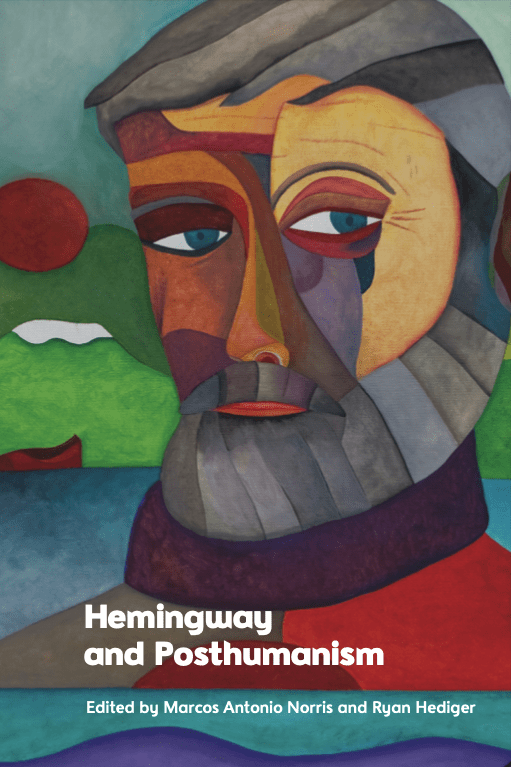
This essay collection explores Ernest Hemingway’s life and works through the perspective of posthumanism, a philosophical movement from the late 20th century that challenges the boundaries between humans, animals, machines, and nature. Emerging in the 1970s and 1980s, posthumanism critiques the human-centered focus of traditional humanism. Scholars like Donna Haraway, Ihab Hassan, and N. Katherine Hayles used the concept of the cyborg to blur distinctions between human, animal, and machine, reimagining cognition in the digital age as a collaboration between artificial intelligence and cyborg-like entities. More recent posthumanist thought questions core humanist principles, such as prioritizing individual humans over communities (including nonhuman ones), favoring rationality over embodiment, and ignoring realities like death, disability, and limited rationality. Hemingway’s works resonate with posthumanist ideas through his focus on humanity’s creaturely existence, participation in authentic ecosystems, engagement with technology and prosthetics (especially in depictions of injury), and skepticism toward modernity, economic progress, and labor norms. This collection illuminates how Hemingway’s narratives underscore the entanglement of human and nonhuman worlds, challenging readers to rethink traditional notions of identity and agency in a rapidly evolving technological and ecological landscape.
Hemingway and Agamben: Finding Religion Without God. Edinburgh UP 2023.

My second book, Hemingway and Agamben: Finding Religion Without God (2023), builds on Agamben and the Existentialists to resolve a longstanding debate over Hemingway’s religious beliefs. Scholars have depicted Hemingway as either a devout Roman Catholic or as a secular existentialist. I argue, however, that Hemingway was simultaneously religious and nonreligious, a secularized theist who, like his friend Jean-Paul Sartre, imbued sovereign choice with divine authority. The dehumanizing effects of war convinced Hemingway of God’s death by reducing mankind to an animal shorn of the imago Dei. But Hemingway arrives at this conclusion only to rebel against it, affirming the superiority of human life through the ritualistic killing of dangerous animals. This sovereign act of domination resurrects the imago Dei in Hemingway’s mind by transforming an ideological construct—namely, human identity—into an ontological essence. This ontological essence ensures the objective moral value of human life, which, in turn, provides the basis for a prescriptive moral code. Hemingway and Agamben concludes that moral absolutes designed to protect human rights are, in fact, the tools of sovereign domination, not of social justice. One cannot recognize human rights as an intelligible concept, I argue, without first enforcing a cognitive distinction between humans and nonhumans, who are subsequently deprived of the same rights. As Agamben argues in “Beyond Human Rights” (1993), social justice is only ever achieved at the expense of nonhumanity.
Agamben and the Existentialists. Edinburgh UP 2021.

My first book, Agamben and the Existentialists, an essay collection I co-edited with Colby Dickinson, explores the relationship between human identity and the death of God. Inspired by Friedrich Nietzsche, whom Terry Eagleton calls “the first real atheist” (Culture and the Death of God, 2014), the existentialist philosopher Jean-Paul Sartre argues that humanity lacks a fixed ontological nature in God’s absence. I demonstrate, however, that Sartre contradicts himself, essentializing human identity to preserve the objective moral value of human life, from which he derives a prescriptive moral code. As he confesses to Simone de Beauvoir late in his career, “I’ve retained one single thing to do with the existence of God, and that is Good and Evil as absolutes” (Adieux, 1984). Sartre rejects God but retains the imago Dei, a Christian concept for the objective moral value of human life. But Sartre’s secularization of a theological concept—this image of God without God—is deployed by modern democratic societies, Agamben argues, to dehumanize entire sectors of the populace. Sovereign leadership erects arbitrary divisions between humanity and nonhuman lifeforms—assigning superior value, or the imago Dei, to select bodies—in order to justify its mistreatment of second-class citizens and other vulnerable people groups. I conclude on these grounds that secular existentialism imbues sovereign choice with divine authority.
 marcosantonionorris.com